A Casa da Velha
The Grandmother’s House
Explore the House
Our Activities
People & support
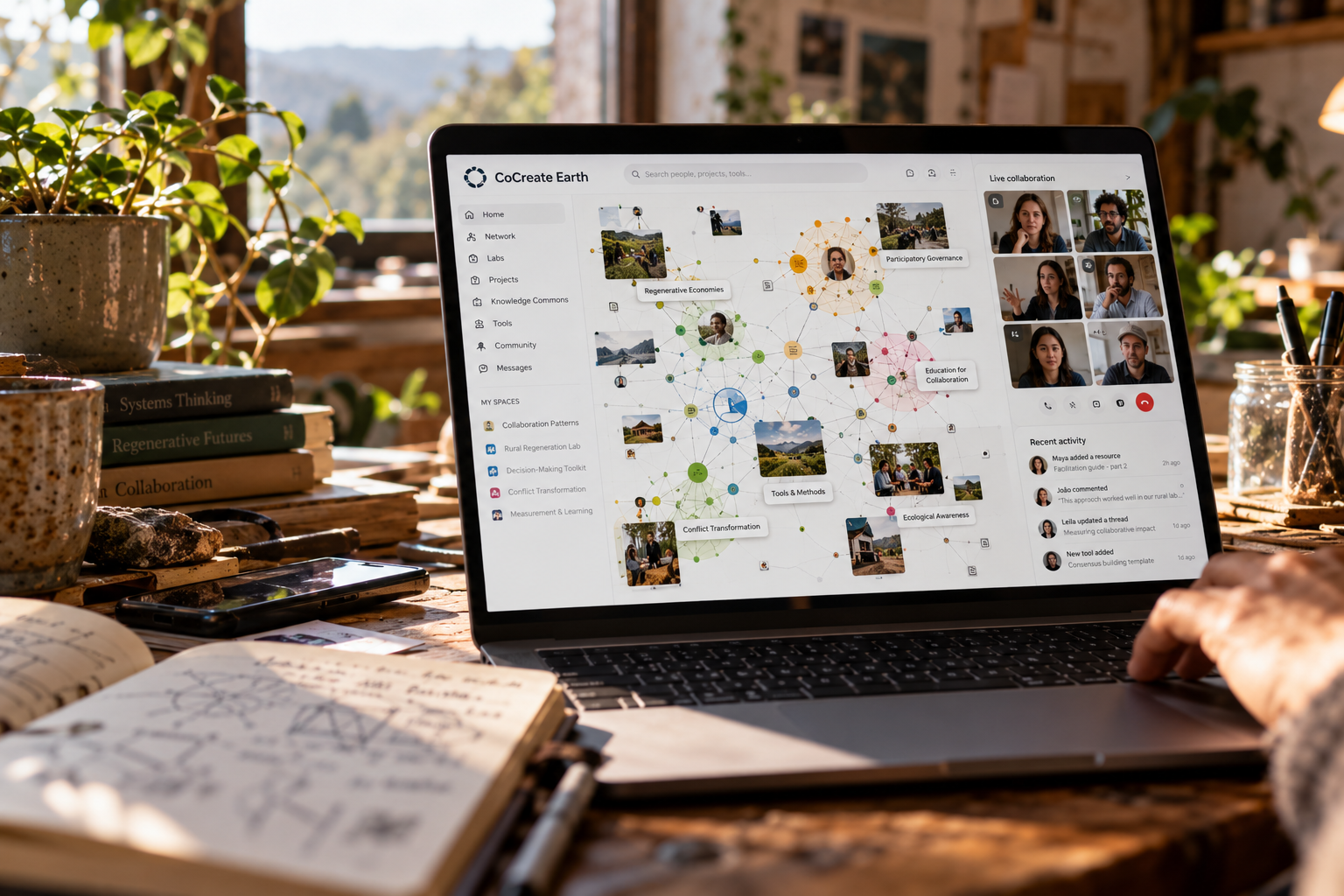
Meet CoCreate Earth Partner
Transformative Collaboration at scale. Capturing the signals of collective evolution.
The real measure of collaboration is not just the results people achieve, but who they become in the process. That's what we measure and scale.
Illustrative vision · AI-generated
CoCreate Earth Labs
Partnerships for the Goals
We want to build and test concrete economic and social frameworks that make cooperation viable, measurable and demonstrable, across SDGs.
Knowing the importance of high-quality digital infrastructure, data tracking and standardized metrics for demonstrating real-world impact, A Casa da Velha partners with CoCreate Earth Labs for technology and collaboration expertise. Together, we build measurable processes into our daily workflows from day one.
The Sustainable Development Goals are a shared reference for the work; their use does not imply United Nations endorsement.
CoCreate Earth Labs
The hardest part of changing the world is often invisible: Learning how to change together.
Humanity is not short of urgent challenges, knowledge, imagination or technology. Yet even where people care deeply, collaboration can break down under difference, power, history, conflict, uncertainty and competing ideas of success.
CoCreate Earth Foundation is a non-profit committed to addressing the root causes of the ‘ collaboration gap ’ : the distance between people’s intention to work and grow together, and their actual ability to do it. We seed, support, and connect initiatives that develop the places, practices and shared intelligence through which people can strengthen collaboration capacity under real conditions.
CCE Labs Network is the first, of many, programmes, instrumental for the emergence and consolidation of the Foundation’s long-term strategy for partnerships and initiatives.
CoCreate Earth Labs
CoCreate Earth Labs Network, In a Nutshell
The Foundation's first Program to support is the creation of the CCE Labs Network: ' A digital platform / decentralized network for the open-source development of collaboration expertise and commons ', because the aim is not to create one organisation with the answer, but a growing ecosystem capable of generating better answers together.
"Imagine a network of laboratories where the subject is not a material or molecule, but the hidden chemistry of collaboration"
We connect initiatives, social laboratories, that align with the open-source development of applied research, expertise, and tools that facilitate emergence of collective intelligence that is grounded in ecological awareness.
We bring people together around real collaboration challenges, provide the digital workspace structure and open-source governance, through which participants can investigate what enables or obstructs joint action, co-design, test possible responses, measure and turn useful learning into programmes, methods and tools that can travel.
Our underlying mechanism / research loop:
Real challenge → collaborative process → observation → research → prototype → testing → documentation → Commons → adoption → feedback → next cycle
Real challenge → collaborative process → observation → research → prototype → testing → documentation → Commons → adoption → feedback → next cycle
Open-source expertise network
A multifunctional, AI-assisted platform supporting decentralised collective research, prototyping and curation of the Earth Collaboration Commons (ECC).
Outputs can include knowledge, project and team workspaces; agentic systems specialised in human collaboration; decision-making and governance templates; and sandbox tools for research and education.
Earth Collaboration Commons
Frameworks, practices and tools that grow across cultures, learn through use and strengthen transformative collaboration at any scale for sustainable development.
Outputs can include patterns and insights, modular facilitation and governance models, decision-making systems, conflict transformation practices, educational programmes, partnership blueprints, research instruments and standards frameworks.
Everything we learn, we share
Knowledge about collaboration is developed as a commons: openly documented, tested, challenged, adapted and improved by those who use it. The aim is a growing ecosystem capable of generating better answers together.
CoCreate Earth Labs
CCE Labs Network & A Casa da Velha
We envision a co-creation loop: Labs develop and test collaboration knowledge; autonomous partners apply it, challenge it and improve it in their own contexts.
Our intended role for A Casa da Velha is an autonomous partner working towards the Sustainable Development Goals. The House would use CCE Labs governance practices and digital tools, help peers across the network, and contribute to research by testing tools, documenting experience and giving feedback. Local decisions and responsibilities stay with the House.
Turning shared goals into working capacity
Shared aims need ways to coordinate work, learn across connected goals and understand what changes locally. Research on SDG implementation highlights gaps in coordination, institutional capacity and attention to local conditions. It also questions approaches that privilege what is easy to quantify while overlooking complex social realities.
For the House, the partnership is a practical response: document decisions and trials, define useful measures with participants, combine evidence with lived experience, and revise what does not work. Shared digital workspaces and research instruments can make learning easier to inspect and compare, without treating one metric as the whole story or assuming the tools alone prove impact.
Applied research · depth
CCE Labs.Network
Current focus: autonomous social laboratories investigate real collaboration challenges and co-develop the Earth Collaboration Commons. Trials, observation and feedback strengthen practical knowledge about how people and systems become capable of acting together.
Collective intelligence · scale
CCE Partners.Network
Future direction: autonomous SDG initiatives adopt and adapt useful practices, test tools, share experience and help peers. Partners can contribute by identifying a need, trying a pattern or giving feedback; becoming a researcher is not a condition of participation.
Useful learning travels both ways
A real challenge at the House → a shared research question → a prototype or practice → a local trial → observations and feedback → an improved commons → another community’s adaptation.
The commons can bring together research instruments, governance frameworks, digital tools and a community of practitioners and builders. Each cycle should make the methods easier to question, reuse and adapt under real conditions.



DaVelha
A Casa da Velha / The Grandmother’s House.
Sprouting people and initiatives through Kinship and Livelihood.